Subscribe

RSS Feed (xml)

Powered By

Skin Design:
Free Blogger Skins

Powered by Blogger

Sunday, February 23, 2014

Taking literature back home

Through the Writers’ Caravan, organisers hope to inspire potential writers by taking established writers as living testimonies to the communities, writes Dennis D. Muhumuza.

“Taking writers back to their communities” as the literary journey is dubbed, will see 10 of the country’s best writers tour the country for 11 days, engaging in literary activities. Some of these activities will include public readings in schools and universities, poetry recitals and performances, community discussions, visiting public libraries and writers’ groups, and crown it with an event back in Kampala with a public reading at the Uganda Museum on February 17.
Some of the caravan writers before set-off

These writers will travel from Kampala to Wakiso, Luwero, Gulu, Oyam, Lira, Ngora, Kapchorwa, Mbale and Jinja where they are sure to relive several memories as they share their stories and interact with their communities.

“The aim of the Caravan is to create a shared space for conversation between writers and their communities,” says Femrite coordinator Hilda Twongyeirwe.

She is validated by Glaydah Namukasa who, when she gets to her home area in Wakiso, will not only talk about how her writing is connected to the community but hopes to get “known in my community as a writer, and inspire students in the school I went to that they too can make it.”

Julius Ocwinyo, who will be the headliner in Lango where he is born, says there is more to gain for the literary industry when its writers get to meet the wanainchi, some of whom have heard about these writers but are clueless about the relevance of what they write: “It’s all about establishing that link with writers and the community. We are saying, ‘Look this is the relevance of what we do as writers; we draw inspiration from here, and by giving out books we are growing their literacy and raising awareness.”

It will also be a time to show the communities that these writers have never lost touch with what culturally distinguishes them. For example, Nakisanze Segawa will perform a Luganda poem, Zibogola (a poem about the African drum and how it communicates) at her former school, Mwerere Secondary School in Luwero. It will be her way of telling her audience that you can earn a living through writing and performing traditionally-inspired poetry.
s
Beyond talking about her writing, Beatrice Lamwaka will give out books to students of Sacred Heart Secondary School and Gulu High School near her rural home as a way of celebrating Ugandan writers and motivating them to dream more.

Funded by Prince Claus Fund for Culture and Development, and in partnership with Kampala Capital City Authority, the project is hoped to raise awareness about Ugandan literature and deepen its reception by the communities.

“It is hoped that at the end of the Caravan, the writers will be inspired to write short stories or poems, which will be translated in their local languages,” says Twongyeirwe. “These will be published by Femrite in a multi-lingual anthology that will be distributed back to the communities that will be visited.”

The writers
Prof Timothy Wangusa. Poet and novelist
Beatrice Lamwaka. 2011 Caine Prize finalist
Julius Ocwinyo. Author: Fate of the Banished.
Glaydah Namukasa. Femrite Chairperson
Austin Bukenya. Critic, dramatist
Laury Ocen. Author: Alien Woman.
Peter Kagayi. Literature teacher/poet
Nakisanze Segawa. Poet
Simon Peter Ongodi.Multi-lingual writer
Betty Kitiyu. Poet.

--Saturday Monitor, February 15, 2014

Wednesday, February 5, 2014

Writing to transform society

BY DENNIS D. MUHUMUZA


Just where does she get the time? It was the question on the lips of many when Gender, Labour and Social Development minister and Bushenyi District Woman MP, Mary Karooro Okurut, launched yet another novel, in Kampala, at the weekend.
Mary 'Mother-Hen' Karooro Okurut
To this, she answered simply, “I love telling stories, and it’s not difficult to find time to tell stories.”
Potiphar’s Granddaughter, published by Totem Publishers, is her latest story; summed up as “a tale of love, forgiveness, and resilience amidst the pain that follows betrayal and suffering”.

The writer assured guests that “once you take this book into your hands, it’s difficult to put it down!” Only those who have read the 271-page volume have the right to question the veracity of her claim.
But jab Karooro with a needle, words are bound to pop out instead of blood.

Before she linked up with Goretti Kyomuhendo to found the Uganda Female Writers Association (Femrite), Karooro was already an accepted and admired author of The Official Wife (1994), The Invisible Weevil (1994) and the play: The Curse of the Sacred Cow (1994). She has also authored short stories, children’s fiction and newspaper articles to cement her position as one of Uganda’s most prolific women writers.

No man has a better grasp of her obsession with literature than John Nagenda, an enviable wordsmith himself. At the launch of Potiphar’s Granddaughter where Nagenda was chief guest, he revealed that when President Museveni first sought his advice on appointing Karooro Presidential Press Secretary, Nagenda opposed the move, afraid that politics would keep Karooro away fro
m writing. He was wrong.

“Mother Hen,” as she’s fondly labelled by Femrites, kept writing, and has more eggs to hatch. In fact, Potiphar’s Granddaughter will be followed by The Switch, which will be about female genital mutilation, and The Man with the Olive Branch, which draws from the life and times of President Museveni.

Why she writes
Karooro writes to “change our realities into a better reality and for the generations to come. She is also inspired by Uganda’s dismal reading culture and wants to create relevant reading material that would impel school-goers and other Ugandans to read ravenously.

“We (writers) act as cultural ambassadors; we tell our story,” she says.

According to John Nagenda, there is everything to love about words. “God is a very wise creator; it’s a miracle to me that people can speak, and writing is so fantastic,” he said. “When you get to a point when people are writing exciting stuff, then you know you are in the presence of beauty!”

He advised up-and-coming writers to read widely and measure themselves against the best writers.

--Saturday Monitor, February 1, 2014

Monday, January 27, 2014

We are fleeing from the high maintenance girl

BY DENNIS D. MUHUMUZA

I was chatting with an OB I had not seen in a while. He asked when I was planning to get married, and I confessed that I am determined to put a ring on it this year. “I hope your woman is not a high-maintenance girl,” my friend said. “Those ones are not marriage-material; they should be avoided like a scandal!”
It struck me that I had heard the expression “high-maintenance girl” (hereafter called HMG) before but didn’t have a true picture. So, I run to my Facebook friends for elucidation, and gosh the things they said about HMGs!

My colleague Daudi even extracted a meaning for me from urban dictionary. It says a HMG is one who has expensive taste (on the man’s account, of course!), is constantly concerned about her appearance, feels she is hotter than most girls, and usually judges others based on outward appearance.

This was put in proper perspective by Herbert who said the HMG expected her man to have an exclusive weekend budget to the tune of millions because she has to shop at high-end places like Forest Mall, go for a Shs200,000-movie at The Hub, tell you to park at some posh salon and wait on her while the hairdresser works magic on her hair, does her manicure, pedicure, massage, and facial makeover. Meanwhile, you are still waiting for her!

Then, Lauryn said the quickest way to spot a HMG is to look at how high her heels are: “If they are past two inches, run for your life!” It’s with these filthy-expensive spike heels that she announces her presence as they clang on the tiles and make heads turn.

Even more, a HMG never holds one phone for long. Peter says when she asks if it is okay to give away her I-phone to her “Baby Sis” because she heard the Samsung S4 takes better pictures, she is the one!
When KFC, which sells chicken in bucket-fulls hit town, HMGs immediately dumped other chicken hangouts for KFC. “To them,” says Dan, “the chicken from other restaurants is usually diseased!”
In short, according to Kenneth, the HMG is one who “takes more money out of your wallet than you can put in!”

Interestingly, men love hanging out with these girls even when they pay through the nose for their company. Yet, they avoid them when looking for wives. Most girls that are labelled by the press as “beautiful but unlucky” are often HMGs.

“Many men would really love to hang around a HMG but when the marriage equation comes in, it becomes a different situation altogether,” Dan explains. “You probably want to hang around with this suave chic, but deep inside you are thinking that if you got married and you hadn’t built a house, she would want you to rent a posh flat or upscale house of Shs2m a month.”

Miriam also has an inkling why HMGs cannot make wives: “They usually look good all the time, the reason you can never eat supper at home since she can’t wash the dishes.”

Sound off : Does being high maintenance necessarily mean not marriage material?
“That is just something girls use to set a standard for who should approach them. We just play with the man’s ego and confidence. Even when they get married, they try to maintain that standard. We should remember though that when a girl loves a man, they usually are not materialistic. There is a possibility of marrying a relatively low standard man. If love is not the reason for marriage, though, money shall talk then.
Bridget Bamulinde, Data Entrant, MTN

“They need money to be happy, always hard to please. Basically annoying. I would say typical high maintenance women are not marriage material. However, there are women who are high maintenance at their own expense (the financially independent).
Agnes Akello, Statistician 

“They are definitely marriage material, if you can afford them. And all guys deserve one because she motivates you to earn. Usually, such girls are actually capable of taking care of themselves. Because if you want something, you will earn it. People that judge them are those that get comfortable living the low life. They only want to live the life she deserves.
Sheila Atukei, University student 

--Saturday Monitor, January 25, 2014

Monday, January 20, 2014

He dropped out of school for 18 years

He has fought for every drop of greatness in him. Without a transcendent desire to acquire university education and the resolve never to give up, he would not be who he is today, writes Dennis D. Muhumuza

It is said some people are born great and others have greatness thrust upon them. But Rwabatongore Rweishe has fought for every drop of greatness in him. Without a transcendent desire to acquire university education and the resolve never to give up, he would not be who he is today, seeking to represent the people of Rubabo County in parliament in 2016. 

Mr. Rweishe is eying the Rubabo County parliamentary seat in 2016
For 18 years, Rwabatongore deferred his dream because of circumstances beyond his control. The first obstacle struck in 1983 when he completed primary school. His father told him that was enough education since he could now write his name and speak some English. 

“As heir apparent you must stay home and learn to be a responsible man when I’m gone,” said Rweishe’s father, shattering his son’s dream. His parents Elnest and Joselyn Rwabatongore of Nyakabungo village, Buyanja, Rubabo County, Rukungiri District, did not want their only child out of their sight. They reasoned that there was no need for him to study more since they had enough wealth to give him a comfortable life.

Rweishe kept home for nine years, but never gave up cajoling his parents to let him return to school. In 1992, his father relented and sent him to the nearby Nyabutete Secondary School. Rwabatongore,20, was the oldest student in Senior One with a moustache already forming . 

Soon Rweishe won over fellow students with his outgoing personality and eloquence. He was appointed the Chairman School Council and became a vibrant student leader who was not afraid of confronting irresponsible teachers.

“I once asked a drunken teacher what precedent he was setting by being drunk,” he says adding, “The teacher later became my friend and interested me more in politics by telling me that John F. Kennedy had eight brains and had not even used half of them by the time he was assassinated in 1963.” 

It stirred in Rweishe the belief that to be a great leader you must be very intelligent and knowledgeable. He started reading everything he could find about exemplary leaders. 

“I was profoundly stirred by Kennedy’s challenge to fellow Americans asking what they can do for their country instead of asking what their country could do for them.”

Since then, Rweishe vowed to serve his country as president one day. He began by sharing what he read with the wanainchi to empower them. When he completed O-Level in 1996 at the age of 24, he joined Universal High School in Kampala because it was easier to access books and vital information in the city.
But tragedy struck in 1998 just after Rweishe had completed high school. His father died. Being an only child, he shelved his university plans and stayed home for another nine years comforting his mother and taking care of their home. 

In 2007, at the age of 35, Rweishe applied and was admitted to Kampala International University for a Bachelor of Arts in Public Administration on the long-distance scheme. This gave him the flexibility to take care of his three children while he studied. He had married and had a child those days he stayed at home at the urging of his parents. But as fate would have it, his wife had died after their third child, and Rweishe chose not to marry again until all his children are grown up and independent. 

At the time he was studying for his degree, Rwabatongore also pursued a diploma in Mass Communication at the Uganda Institute of Business and Media Studies, as well as a certificate in Administrative Law at the Law Development Centre (LDC). 

He is so concerned with using his discoveries to empower the larger community in Rubabo County where he moves from home to home teaching them how to increase their produce and earn income for self-substance and for investment. 

As a farmer and cattle keeper’s son who was raised on the farm, he understands agriculture and animal husbandry and argues that these sectors alone have the capacity to eradicate poverty, unemployment and boast the Ugandan economy. He showed me a 50-page manuscript titled ‘15-Point Program for National Development’ in which he articulates things that can transform this country from the grassroots and keep it on the economic growth curve.  

"Uganda’s arable land of 5200000 hectares’ produces 610000 metric tones of banana but most of these bananas are not being processed to benefit the economy on a grander scale,” says Rwabatongore. He proposes an Act of Parliament that will establish the Ministry of Food Processing to advance food processing and production. He also wants the government to open an agricultural bank where farmers may get loans to improve and increase their output.

Rwabatongore is passionate about his ideas on empowerment and transformation. He reels off statistics with the adroitness of a professor to back his arguments. He accuses the current Rubabo Country MP Paula Turyahikayo of being a politician rather than a servant of those who elected her, which is why he has chosen to take her on in 2016. 

“A politician is concerned about his lofty office and the allowances he gets while a servant always touches base with those he represents and collects their ideas for implementation,” Rwabatongore explains. “As Jesus said, a great leader must be a great servant.” 

Sunday, January 5, 2014

2014 promises to be a better literary year

It appears most writers’ major resolution this year is to release more books and continue to grow the industry to high standards, writes Dennis D. Muhumuza

The excitement that comes with the folding of the year (2013) and the unfolding of the new one (2014), has not spared Uganda’s literature fraternity either. The writers’ major resolution is to release more books in this year and continue to grow the industry to high standards.

The death of literary guru Chinua Achebe in March 2013 was seen as the coming down of the curtain on the old-school writers, whose works have dominated the industry for decades, and the beginning of the real shining of a new generation of African writers whose works are enjoying rave reviews worldwide.

Setting the pace is Nigerian author Chimamanda Adichie, 35, whose newest book, Americanah, is a must-read in 2014. When Adichie released Half of a Yellow Sun after her first novel, Purple Hibiscus, she was described by Chinua Achebe as “A new writer endowed with the gift of ancient storytellers.” No doubt her star will continue to twinkle this year.

In my opinion, however, NoViolet Balawayo of Zimbabwe is better than Adichie, and if you haven’t read any of her works, you must do so this year. If you are looking for one African novel to read this year, I recommend We Need New Names, which made the 2013 Man Booker Prize shortlist, making Balawayo the first black African woman and Zimbabwean to make it there.

For the non-fiction lovers, you must not miss The Hero Within, the autobiography of Dr Jane Kengeya Kayondo. Released in November last year, this is a brutally honest odyssey of her life from poverty to becoming the first Ugandan woman epidemiologist, and the first to study Aviation Medicine. The autobiography also inadvertently serves as a commentary on Uganda’s politics, especially in the 1970s. A must-read, I tell you.

Last year saw the launch of Writivism, an initiative aimed at spotting and nurturing new writing talent. The participants were taken through mentoring process and wrote short stories, which were published in the local press. The finest of those have been anthologised as Picture Frames and Other Stories. The initiative is continuing from where it stopped, and this time is involving the rest of Africa.

Last year's Writivism participants
According to Brian Bwesigye, the brain behind the programme, they have already received 120 applications from emerging writers across the continent. Ten training workshops will be held; two in each of the countries of Uganda, Kenya, Nigeria, Zimbabwe and South Africa. It is in these workshops that the emerging writers will be paired with writing mentors and a short-story prize will be introduced. Such initiatives are timely in positioning the emerging African writer to relay the African story with experimentalism never before imagined.

The Uganda Female Writers Association (Femrite) also continues in pushing the woman writer into the arena of excellence. Just last year, Femrite launched African Violet and Other Stories, an anthology of 15 stories, including the five short-listed for the 2012 Caine Prize at an event in Kampala attended by the 2012 Caine Prize winner, Rotimi Babatunde. This is an anthBombay’s Republic, and Beatrice Lamwaka’s Pillar of Love.
ology worth reading for its exceptional variety, including Babatunde’s hilarious hit,

Uganda’s literary industry, though still held back by low participation in local prizes, and blinded by the search for western/outside approval by the writers themselves, will perform way better this year than it did in 2013.

--Saturday Monitor, January 4, 2014

Thursday, January 2, 2014

Dancing, rejoicing and worshipping

As the world waits for the midnight hour that will usher in 2014, millions of believers will be reaching out to God, writes Dennis D. Muhumuza

On the night of December 31, Makerere Full Gospel Church, the first Pentecostal church in Uganda and its sister churches in the city, will gather at Makerere University main sports ground for an overnight service and celebration of the end of the year. The story will be the same in many other venues around the country as churches have made it a custom to end the year with an all-night spiritual jamboree characterised with hyperactive performances from the best gospel musicians, dancers, actors and comedians, complete with plangent fireworks.

Pr. Fred Wantaate at the pulpit with a mic leads church members in prayer
Long gone are the days when such events were left to the secular world with multitudes cramming sports venues like Namboole and Nakivubo stadiums to be entertained by musicians. Others would gather in strategic spots with a panoramic view of the city, to watch the fireworks. According to Ivan Wobusobozi of Redemption City Church, evangelical and Pentecostal leaders of more than 1,500 churches in Uganda, have adopted popular ways of ushering in the New Year, but retained the spiritual and transformational angles without taking away the fun and excitement.

But how important are such overnights? According to Pastor Fred Wantaate, the senior pastor of Makerere Full Gospel Church, the last day of the last month in a year is special in the lives of many people for it signals an end to a season and announces the beginning of a new season.

“For many Ugandans it is time to congratulate themselves for having “survived” another year. It is therefore in order for them to celebrate and thank God for enabling them to go through another year,” says Pr. Wantaate. “It is also time to rededicate oneself for next season in prayer, set goals and make resolutions. It is a time to be spiritually recharged and rebooted for the next journey of 12 months. Ugandans repent and pray for their leaders and families.”

Unlike last year’s overnight which focused on prayer, this year’s event has been dubbed a family affair where parents and children will feast on food, tea and cake, with fireworks display to last at least five minutes. There will be no long brimstone sermons admonishing congregants to live pure lives in the next year lest they perish. Rather ordinary Christians will testify of the goodness of the Lord, according to the cleric.

And in line with the night’s theme, “Praise Precedes Victory”, emphasis will be on celebration and thanksgiving with lots of music and dance. The theme is drawn from 2 Chronicles 20 in which King Jehoshaphat is led by God to respond to the fear of imminent destruction with praise and worship. He received a revelation that spiritual worship is the ultimate ambush against Satan and all his designs. And when the king and his men marched to war singing and praising God, the Lord set an ambush against the men of Ammon, Moab and Mount Seir, who had come against Judah, and they were so defeated that it took three days for Jehoshaphat and his people to carry away the spoil from the battlefield which they baptised the Valley of Blessings.

“Many Ugandans are facing the unknown; the future is littered with serious physical, financial, marital, economic and career challenges. But just like Israel, we must turn our fears and doubts into spiritual praise and overcome our challenges even before we enter the New Year,” Pr. Wantaate says.

May God bless you in the New Year.

--Sunday Monitor, December 29, 2013

Sunday, December 22, 2013

Teaching children of Uganda’s presidents

Go-getter: An outstanding educationist, loving mother and wife, Mary Mulumba has left her footprints in the lives of many in her journey of life, writes DENNIS D. MUHUMUZA

She has had the privilege of teaching the presidents’ children, but most remarkable about the life of Mary Mulumba is how she rose from being a nursery teacher to owning one of the most prominent urban primary schools in Uganda- Kampala Junior Academy (KJA).

Her big brother, Samuel Baddokwaya, believes his sister’s success has much to do with God’s favour and hard work. He still remembers a prayer she said at a Chr
Mary and her husband
istian gathering when they were still very little: “‘Me Mary, please God help me, Amen!’ And sincerely God has helped her ever since, because no one in our family has achieved as much as she has.”

Mulumba was born in Mengo Hospital, on Christmas day in 1941, the second of Rev. Canon Yakobo Gabunga Baddokwaya and Ruth Baddokwaya’s eight children. Her father was a teacher and schools inspector before he became a full-time minister serving in the Church of Uganda.

She remembers that their home in Busega was always full of born-again Christians and members of Mothers Union who often came for prayer and fellowship. She says they taught her to pray and sharpened her interpersonal relations and communication skills.

“I also learnt a lot from my father who often took me along with him to visit his friends, inspect schools and supervise some church projects. It was his way of teaching me hard-work and protecting me from bad influences by keeping an eye on me,” she says.

Attaining an education
Mulumba grew up at a time when the education of girls was not prioritised. Luckily, her father had a different perspective and educated all his children regardless of their sex. His mantra to his children was: “Get educated, work hard and look forward to a better future.”

When she joined Primary One at Buloba Primary School, she vowed never to disappoint her father. By the time Mulumba completed Primary Eight, she knew what she wanted to be. In 1957, she joined Ndejje Teacher Training College. She was impressed by how the college Principal, an English lady named Drakely, combined motherliness with toughness. This is the woman she aspired to be like when she left college in 1960 as certified primary school teacher.

Mulumba immediately got her first job at Mengo Girls School. Then something exciting quickly happened – she met the man of her dreams.

The love of her life
Daniel Mulumba had just returned from UK with a degree in Accounting. He was a tall, handsome man. At 25 then, he was suave, collected and a proud owner of a white VW car to complete his stature as the most eligible bachelor then.

At the time, it was prestigious for a young man of Daniel’s age to own a car. So when his mother asked him to drive her to Lweza on Entebbe Road to attend a meeting for born-again Christians, he agreed out of the love and respect for his mother, but also to show off his prized car! This turned out to be one of his best decisions because it is at that meeting that he met Mary, a dazzling 19-year-old beauty fresh from college.
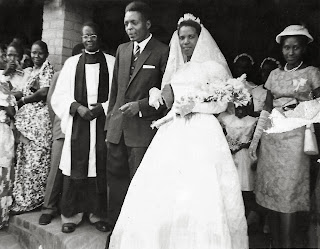
Mary weds Dan in December 1960
A leaf from her journal of the time reads: “In 1960, I met a wonderful, educated, simple and quiet man called Dan Mulumba. We fell in love straight away!” They were married the same year, on December 17, 1960, at Namirembe Cathedral.

After the wedding, the couple moved to Mugongo, near Kyengera on Masaka Road. Four months after their wedding, Dan was offered a job in the Ministry of Finance and moved to Entebbe. Mary had to move back to her parents’ home at Busega in order to keep her job at Mengo Girls School. Later, she joined Daniel in Entebbe and got a job there at Namate Primary School where she taught for three years.

A great opportunity
In 1964, Mulumba was offered a scholarship by the Uganda government to pursue further studies at Stranmillis College in Northern Ireland. She was a young wife of 24 with a husband and three little children, but at the urging of her husband, she accepted the scholarship, and for three years, specialised in Infant Methods.

“Children found me so strange because they were not used to seeing black people,” she recalls. “One child wetted her finger and rubbed it on my arm to see if my skin was made of soil.”

When she returned in 1967, she got a job at Lake Victoria Primary School in Entebbe, as the head of its nursery section. This was a prominent school of mostly expatriate children. Mulumba became its first and only African teacher.

After three years, she was posted to Nakasero Primary School, where she stayed for a year before being appointed the first African Headmistress of Kampala Kindergarten in 1970. This was a school for diplomats and upper class families of the time. The school was located near State House. In the 23 years Mulumba worked there, she taught the presidents’ children from Obote, Amin to Museveni.

She managed to go through the volatile 1970s unscathed, considering many professionals fled the terror and dictatorship of Amin. Mulumba avoided politics. This and prayers, she believes, is what saved her and kept the school operating throughout those perilous times. She had learnt from her father that in life, if one is to make a difference, they must be willing to take risks and make tough sacrifices.

Life begins at 52
Mulumba’s success at Kampala Kindergarten attracted criticism from individuals who started making slighting remarks about her age and how it was time she moved on. She pondered the situation, and in 1993 decided to resign. She was 52 years with no idea that her life would never be the same again.

After combining her savings with her husband’s, Mulumba hired an old building on Clement Hill Road from which she started Kampala Junior Academy. Mulumba believes in the success formula of ‘Think Big, Start Small and Grow Big’ which enabled her to avoid loans and move forward patiently. She started with only nine children, but before a year elapsed, the number had risen to 200, thanks to her credibility.

Herbert Kijjagulwe who has been the Principal of KJA since 1997, says the current location of the school at Yusuf Lule Road was bushy with no clear road. Whenever it rained, muddy puddles would form and cause cars to get stuck. But this did not discourage the parents; they kept bringing their children. Today the road to the school is tarmac, the school has modern storeyed structures,more than 1,000 pupils and employs more than 150 staff. It has grown so that a kindergarten branch has been opened in Ntinda to absorb children from the age of one to four.

Mulumba says: “Three quarters of the pupils in my school are the children of the children I taught in school way back. I’m teaching ‘my’ grand children.”

By 7am, she is already at school, shaking the hand of each of her pupils, greeting each by name and speaking words of affirmation to them. At break-time, they gather around her like bees around nectar, freely playing on her laps, asking questions and telling stories. The warmth on Mulumba’s face says this is a company she would not exchange for anything.

“She is a mother to us teachers too,” Robert Kimuli Kaweesa, a teacher at KJA says of Mulumba’s heart of gold. “On top of ensuring that we get our salaries on time, she is helping us with school fees. We have our children in this school and we pay subsidized fees in small installments. Ms Mulumba is really an angel to us.”

As an educationist of excellence, Mary has won several awards from reputable organisations like Rotary Clubs, Nile Breweries and the Nabaggeka Trust among others. Her biography titled; Woman of Action was launched on December 14, 2013, by Her Royal Highness Sylvia Nagginda, the Nnabagereka of Buganda.

--Saturday Monitor, December 14, 2013